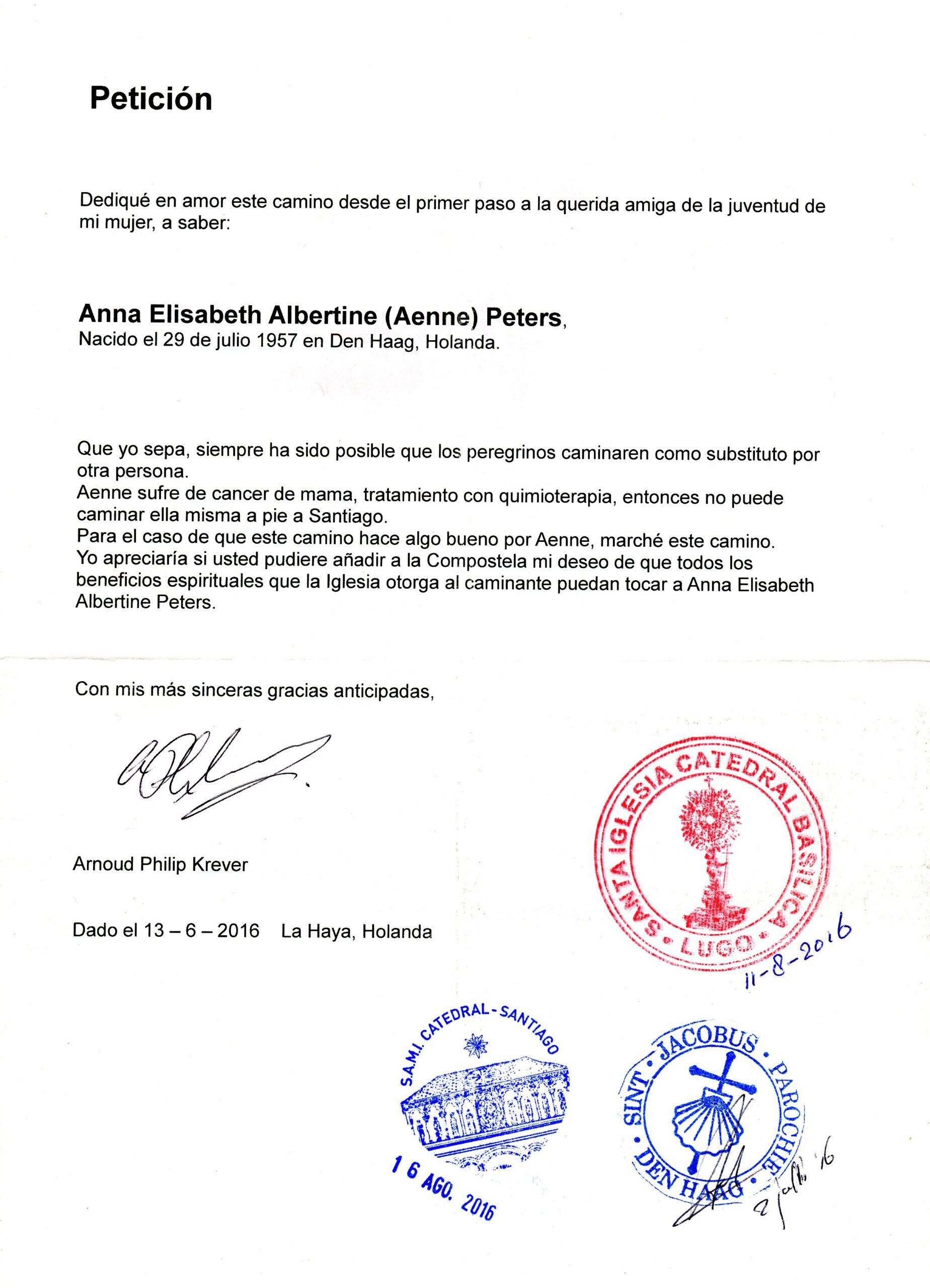
Vicarie pro… to Santiago for someone else
Arnoud Krever
With the cooperation of Pastor Dr. Ad van der Helm, professor of canon law at the University of Leuven
A pilgrim can receive a partial indulgence for someone else and, in a Holy Year, a full indulgence upon arrival. The church sets a number of rules that the pilgrim must comply with.
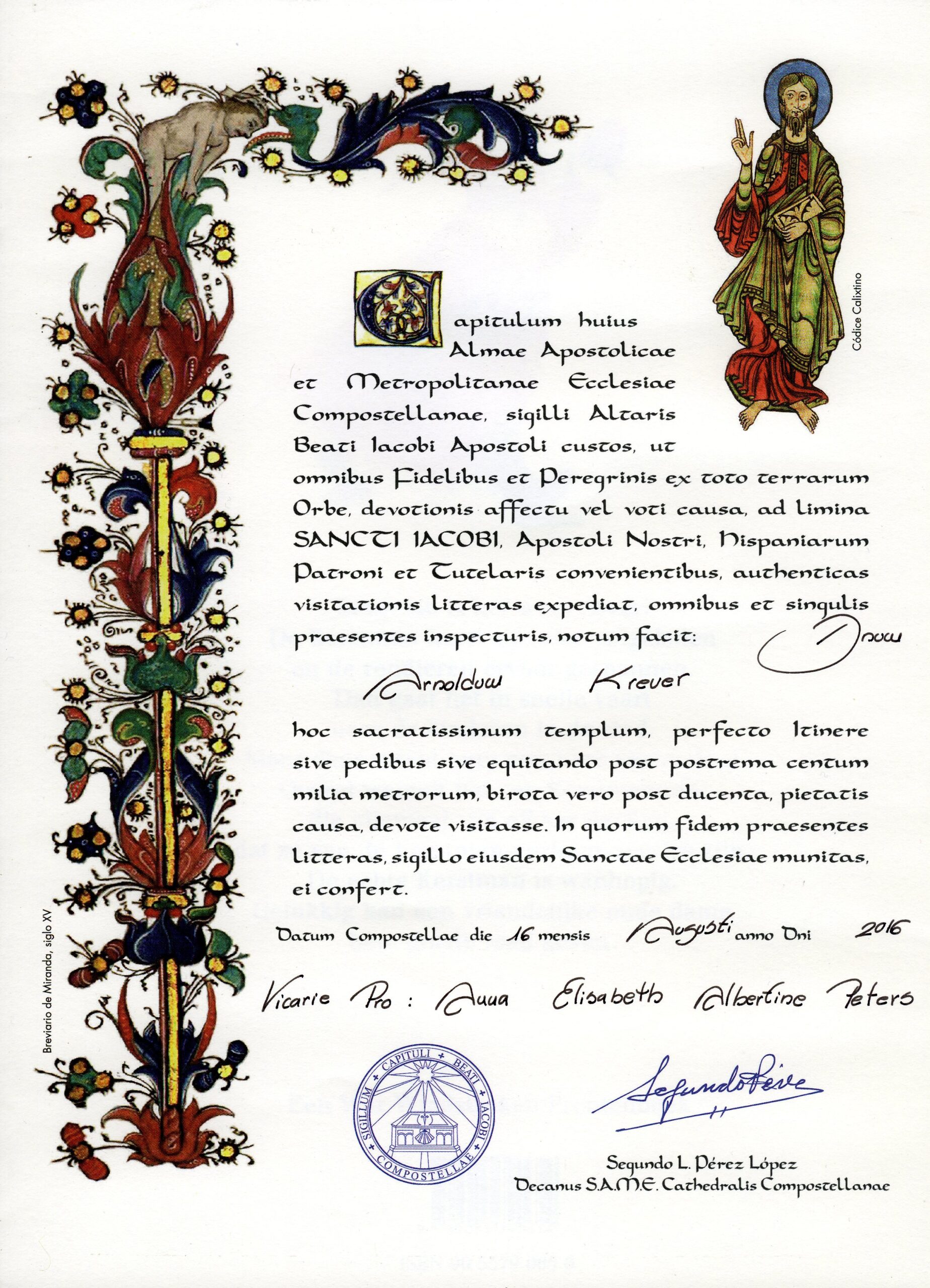
Some of the pilgrims who arrive in Santiago do so in memory of a loved one who has died or to support a family member or friend who is, for example, elderly or seriously ill. These pilgrims can receive a customized compostela (ecclesiastical certificate of arrival) with the name of that person on it. Those who do not mention this purpose of the Camino receive a standard Compostela. That is a missed opportunity and a pity.
A bit of history
In 1122, the construction of the Romanesque cathedral of Santiago was completed. This prompted Pope Callixtus II to declare that it would be a Holy Year in Santiago if the name day of St. James, July 25, fell on a Sunday. The first Holy Year was in 1126. The next Holy Year will be in 2027. This is a different rhythm than in Rome, where a Holy Year is celebrated every 25 years.
Indulgence
A pilgrim arriving in Santiago can receive an indulgence. In a normal year, this is a partial indulgence. In a Holy Year, it is a full indulgence. This means that some or, in a Holy Year, all of the sins committed during the pilgrim’s lifetime will no longer be counted against them after their death.
Church rules
If you walk or cycle to Santiago for someone else, there are two rules that apply. The church only allows you to walk for someone else if that person is unable to do so themselves. Deceased, too old, seriously ill, disabled, too young, or still unborn in the womb are accepted. In the latter case, you must be able to provide a name. “Vita Nova,” Latin for “New Life,” has been accepted as a first name. Furthermore, there must be a relationship between the person arriving at the pilgrim office and the person for whom the journey was undertaken.
For the church, the person for whom you have undertaken the journey is the actual pilgrim. The full or partial indulgence belongs to him or her. You are his or her feet. For you, there is your spiritual growth and the pleasure of walking or cycling.
In a Holy Year, a poster hangs in the pilgrim office with the three requirements for obtaining a full indulgence. This applies to the person for whom you have arrived! The same requirements for a partial indulgence apply in a “normal year.”
- 1. The pilgrim, or his or her representative, must enter the cathedral while reciting a prayer. A prayer for the Church or the Pope is suggested. The person for whom you have arrived and who is at home cannot, of course, do this himself or herself.
2/3. 2/3. Within 15 days, counting the day of arrival in Santiago as day 1, the pilgrim must have received two sacraments. He must have confessed and he must have received communion.
The problem here is that these two sacraments are reserved for people who are Catholic and live in harmony with the Catholic Church. Confiding in a priest does not count as confession for a non-Catholic. Nor is it formally permitted for non-Catholics to receive communion.
On the other hand, the Church has a rule of thumb that “the Mother Church supplements what a sincere person is unable to do.” If that rule applies here, you can assume that the problems are solved.
Furthermore, one might wonder whether the administration in heaven, which knows the pilgrim’s heart, is not much more flexible with the rules that the church has established here below.
The above additional requirements are not checked at the pilgrim office.
At the pilgrim office
A pilgrim must state their motivation for the journey at the pilgrim office. A religious motivation is required to obtain a Compostela. The motivation “spiritual,” which used to be sufficient to obtain a Compostela, could perhaps be classified as “religious.”
If the person you are arriving for is religious, you can state religious without any qualms. You will be asked about the pilgrim’s motivation, which is the other person.
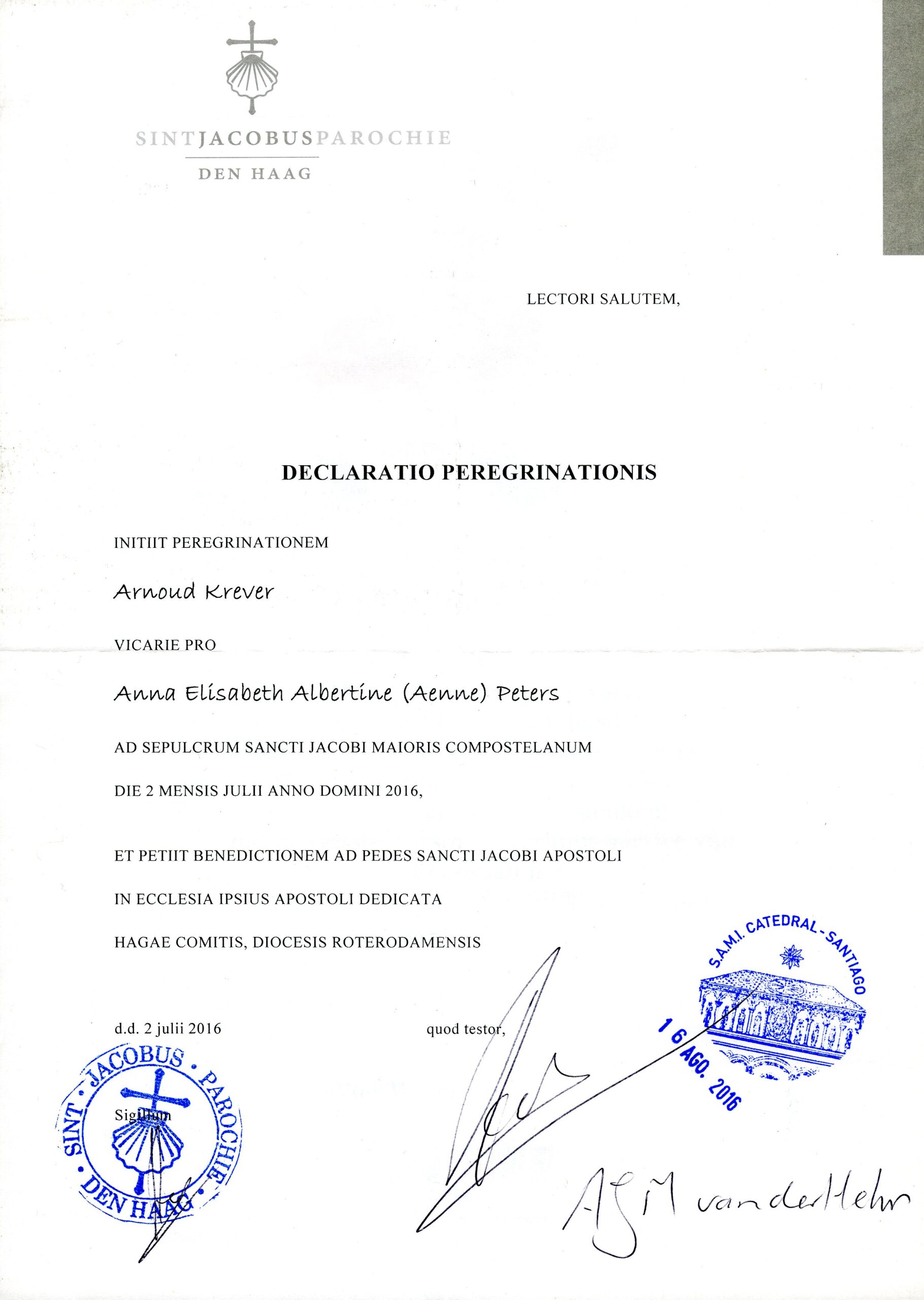
Remember to emphasize at the pilgrim office that you have arrived on behalf of someone else. The magic words here are “Vicarie pro…”, Latin for “Acting on behalf of”. De toverwoorden hier zijn “Vicarie pro…”, Latijn voor “Plaatsvervangend voor”.
The two questions you can expect are: “Why can’t that person walk or cycle to Santiago themselves?” and “What is your relationship with that person?” No supporting documents are required. The compostela will be issued in the name of the person who has arrived, i.e. in your name. At the bottom, “Vicarie pro” will be added by hand, followed by the name of the person for whom you have arrived.
This compostela is the most beautiful gift of mercy you can give to the person for whom you have undertaken the journey to Santiago.
You can read more about this in www.floresdeloscaminosasantiago.eu